
Fireplace Specialist Brand
How we scaled to 6 digits at ROAS 11.9 in 3 months
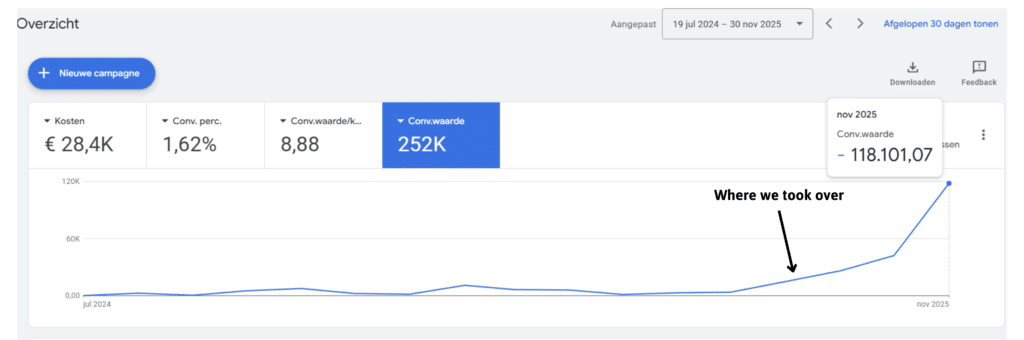
Case study: €118K/month revenue at 11.9× ROAS
Our client is an established brand of decorative fireplaces: bio ethanol and electric solutions that do not require a chimney. When we took over in August, they were already investing in Google Ads. The account looked profitable at first sight, but they were still completely stuck.
On paper the ROAS looked great. In reality they were mainly paying Google to capture people who were already going to buy.
This is how we turned a lazy brand-heavy ad account into a full-funnel engine that:
• Scaled daily budget by a factor six
• Reached €118K in revenue in November
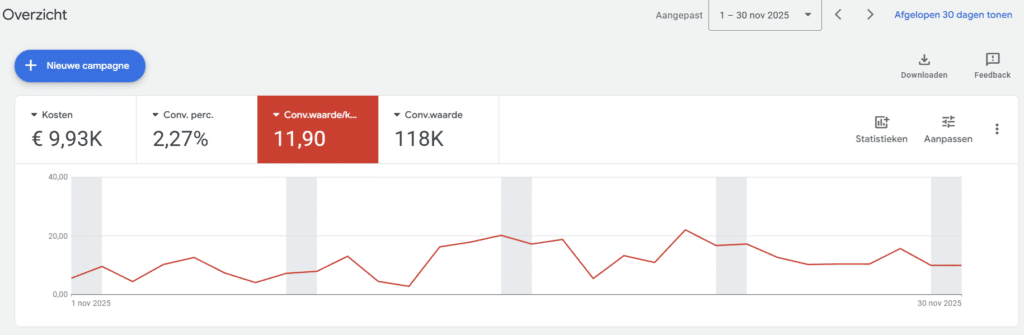
• Achieved an average ROAS of 11.9 in November
• Entered France, Flanders and Germany in the same month
• Ran a Black Friday action without burning too much margin
The challenge: the ROAS Mirage
When we audited the account we saw a very familiar trap.
• Performance Max was doing most of the work with broad targeting and very limited control
• The campaigns leaned heavily on brand traffic: people already searching for their brand name or exact product names
• Generic non brand queries such as “bio ethanol fireplace” or “Cinewall with fireplace” were barely tapped
So yes, ROAS was high. But it was built on easy conversions, not on growth.
The algorithm followed the path of least resistance. It harvested existing demand instead of creating new demand. Whenever they tried to push budget, ROAS collapsed because Google had never really learned how to acquire cold traffic profitably.
New customer acquisition was flat. International potential was sitting idle. The dashboards said success, the business reality said ceiling.
The strategy: split, clean and scale
To break that ceiling we did not simply increase bids. We rebuilt the structure and the data layer underneath.
1. The hard split: brand versus non-brand
First we stopped the algorithm from hiding behind brand traffic.
• We placed all branded searches in dedicated brand search and shopping campaigns
• We removed brand queries from Performance Max
• We cleaned branded search terms out of the existing non-branded search activity
That gave us three key advantages:
• A clear view on true non-branded performance
• Predictable high ROAS brand campaigns that simply harvest existing demand
• Space for Performance Max and non-branded search to focus on acquiring real new customers
2. Full-funnel architecture instead of one big bucket
We replaced the blended setup with a clear funnel structure.
Top of funnel: Standard Shopping for cheap visibility
We launched Standard Shopping campaigns with low cost-per-click limits across core categories such as bio ethanol fireplaces, electric fireplaces, Cinewalls and burners.
Objective: maximum qualified visibility on generic category searches at the lowest possible cost per click.
Mid and bottom of funnel: focused Performance Max for buyers
We used Performance Max in a very deliberate way:
• For warm non-branded audiences
• For dynamic remarketing on people who had already viewed products or category pages
Objective: turn interest into revenue and bring back visitors who were close to purchase.
Structured search that mirrors buying behaviour
We rebuilt search around how people actually shop:
• By technology: bio-ethanol versus electric
• By use case: fireplace without chimney, alternatives for wood or gas, solutions for apartments and TV walls
• By format: built in, wall mounted, freestanding, Cinewalls
This structure told Google exactly which segments matter most and where we can safely push budget.
3. Data hygiene: paying only for the right intent
Next we raised the quality of the search terms we were willing to pay for.
• We excluded irrelevant terms such as wood stoves, pellet stoves and other fuel burning solutions that our client does not offer
• At the same time we expanded and refined non-branded keywords around clean ventless alternatives, the category our client wants to own
Every euro spent now teaches the algorithm the right lesson: who a good customer really is.
4. CRO and messaging: making high value pages convert
With high value products such as Cinewalls and premium fireplaces, even a small increase in conversion rate makes a big difference for scaling.
Together with them, we:
• Shortened and clarified the copy: fewer technical details and more concrete benefits such as “no chimney needed”, “suited for apartments” and “clean alternative for wood or gas”
• Added more social proof: reviews, in home photos and finished projects to reduce perceived risk
• Aligned ad promises with the most relevant product or category pages, especially for Cinewalls and best selling models
This made it possible to send more cold traffic to the site without seeing conversion rate fall away.
5. Smart Market Expansion: France, Flanders and Germany
Once the structure and data were stable we used the same logic to expand into new markets.
Flemish market
We leveraged geographic and language proximity with localised campaigns and messaging that fit the Belgian context while reusing the proven account logic.
France
We launched with controlled budgets, focused on high intent non-brand and Shopping traffic first. Only after confirming stable ROAS did we gradually allow broader signals.
Germany
We started with the strongest generic segments such as bio ethanol fireplaces and used strict keyword and placement control to protect efficiency.
All three markets went live in November under the same disciplined framework: clean data, structured testing and phased scaling.
6. Black Friday: acceleration without margin destruction
Black Friday is often where brands inflate revenue and quietly kill profitability.
For this client, we chose a different route:
• We integrated Black Friday messaging into the existing successful campaign structure instead of creating chaotic one-off setups
• We focused discounts on strategic product lines only, not on the full catalogue
• We monitored ROAS and average order value closely and pushed or pulled back budget per segment depending on live profitability
• We used Seasonality Bid Adjustments by telling the algorithm to expect a 30% lift in conversion rate during this period, followed by a 30% drop the week after Cyber Monday. That let us push harder when purchase intent was highest, while preventing overspend once demand cooled off.
Black Friday became an accelerator inside an already efficient system, not an exception that breaks all rules.
The results: real growth, not just pretty dashboards
With structure, clean data and a clear funnel in place, scaling became a controlled business decision.
Budget scale
Daily ad spend increased from roughly €100 to around €600, always way above ROAS 8.
One month at six figures
In November, combining the original market with the launch of France, Flanders and Germany plus a controlled Black Friday push, Google Ads generated:
€118 000 in revenue (blue line) at an average ROAS of 11.9
Efficiency at scale
Despite aggressive budget growth and multi-market expansion:
• The weekly average ROAS stayed well above the factor ten mark (red line)
• A much bigger share of spend now goes to non-branded high-intent traffic
• We are not just reselling to the same loyal customers
From harvesting to hunting
The most important change: our client now owns a much larger share of generic category demand.
Searches like “buy Cinewall” or “bio ethanol fireplace without chimney” in several languages have become a consistent revenue driver.
Brand campaigns are lean and precise: they protect the brand and no longer mask weak acquisition with inflated averages.
Why it worked
For ecommerce directors and marketing leaders this case is not about a clever trick inside Performance Max. It is about foundations.
It worked because we:
- Separated what must be separate: brand versus non-brand, harvesting versus hunting, awareness versus conversion
- Cleaned the inputs: negative keywords, refined structures and focused feeds gave Google the right data to optimise on
- Aligned funnel, new markets and landing pages toward one goal: profitable new customer acquisition
The result: they can now invest aggressively in growth across multiple countries without sacrificing profitability.
If your own Google Ads account looks impressive in a report but collapses when you try to scale or expand into new markets, you likely do not have a budget issue.
You have a structure, strategy and data issue.
Fix that, and the step from comfortable to category leader becomes a choice, not a hope.
